
|
Recent Articles
| Image | Title & Summary |
|---|---|

|
Students killed in mass attack the second school shooting in 2 days
On Wednesday, a student at a middle school in southeast Turkey opened fire on two classes, killing four people and injuring 20 others, according to an official. This was the second shooting in the nation in two days. Kahramanmaras province Gov. Mukerrem Unluer added that the gunman, who was also murdered, came to the school with firearms that are thought to have belonged to their father, who was a former police officer. The assailant had five guns and seven magazines with him. Unluer reported that the victims were a teacher and three pupils. At least four of the injured were in bad shape. It wasn't clear right away what the attack was about. The attack happened the day after a former student… |

|
Two more people die while skiing in the Lake Tahoe region
There have been two additional fatalities in the Sierra Nevada, adding to the total number of fatalities that have occurred throughout the winter season. The avalanche that occurred on Castle Peak last week killed nine lives. According to the Douglas County Sheriff's Office, which arrived just before noon, the most recent deaths occurred on Friday in two "fatal ski incidents" that were unrelated to each other at the Boulder Lodge of Heavenly resort. In a press statement, the Sheriff's Office stated that paramedics from the Ski Patrol and the Tahoe Douglas Fire Protection District attempted to save the life of the subject. On the other hand, both persons were pronounced dead at the site of th… |

|
The war on Iran will likely end in American retreat
Iran can credibly impose costs that the United States cannot bear and that the world should not suffer. The US – Israel war plan was a decapitation strike, sold to President Donald Trump by Prime Minister Benjamin Netanyahu and David Barnea, the director of the Mossad. The premise was that an aggressive joint US–Israeli bombing campaign would so degrade the Iranian regime’s command structure, nuclear programme, and IRGC senior leadership that the regime would fracture. The United States and Israel would then impose a pliable government in Tehran. Trump seems to have been convinced that Iran would follow the same course as had occurred in Venezuela. The US operation in Venezuela in January 20… |

|
Jordan Jones shot dead
Local police reported that a security officer at a Georgia club was shot and murdered while trying to break up a quarrel between a guy and a woman. The Acworth Police Department reported in a news statement that Jordan Alexander Jones, 28, of Lawrenceville, Ga., was shot and killed approximately 2:42 a.m. local time while trying to break up the altercation. According to the news release, when APD officers got to the site, they "found a victim with a gunshot wound." "As soon as they got there, officers started helping until Cobb County Fire and Metro EMS arrived. The APD said, "The victim was taken to Kennestone Hospital, where he later died from his injuries." The police agency stated it got… |

|
World faces food catastrophe if Strait of Hormuz disruption persists
A prolonged disruption in the Strait of Hormuz could result in a global food “catastrophe”, the Food and Agriculture Organization (FAO) has warned, as shipments of critical agricultural inputs remain blocked in the key waterway due to the US-Israel war on Iran. Food prices have not risen yet because existing stocks are absorbing the shock, the United Nations body’s chief economist, Maximo Torero, said in an interview on Monday, alongside David Laborde, director of FAO’s agrifood economics division. But if traffic through the strait does not resume, the shocks to energy and fertiliser markets will translate into higher commodity and retail prices later this year and into 2027, Laborde added. … |

|
Nvidia CEO Huang denies he is unhappy with OpenAI says 'huge' investment planned
Business TAIPEI, Jan 31 : Nvidia plans to make a "huge" investment into OpenAI, probably its largest ever, CEO Jensen Huang said on Saturday, denying he was unhappy with the ChatGPT maker. The chipmaker in September announced plans to invest up to $100 billion in OpenAI, a deal that would give OpenAI the cash and access it needs to buy advanced chips that are key to maintaining its dominance in an increasingly competitive landscape. The Wall Street Journal reported on Friday that the plan had stalled after some inside the chip giant expressed doubts about the deal. The report said Huang had privately underlined to industry associates in recent months that the original $100 billion agreement … |

|
Florida woman works two jobs to pay student debt
A mountain of student loan debt has accumulated for Rachel Jordan. She's worried that she'll fall farther behind financially even though she's working two jobs to pay off her debt. Rachel Jordan has days that begin at 5 a.m. and don't finish until midnight, sometimes many days in a row. In an interview, she confessed, "I'm just exhausted, honestly." she stated. As he works to repay debts accrued at a young age, 43-year-old Jordan is just one of millions of Americans who must work two jobs just to make ends meet. Jordan puts approximately 70 hours a week on a regular basis to try to pay off his $75,000 in college loans. While Jordan's debts are in forbearance, she is not obligated to make pay… |

|
Behind the moon for 40 minutes the greatest solitude humans have known
This is read by an automated voice. Please report any issues or inconsistencies here. The crescent Earth — our oasis holding everything we cherish, now just a speck in the infinite blackness — seemed to kiss the jagged lunar surface. The moon’s thousands of scars projected themselves across the Earth as it slowly slipped out of sight. “I’m actually getting chills right now just thinking about it,” said Artemis II Cmdr. Reid Wiseman, talking to The Times while still in space Wednesday evening (Earth time). “It was just an unbelievable sight, and then it was gone.” For 40 minutes Monday, it was just them, their high-tech lifeboat and the moon. The crew members paused their rigorous scientific … |

|
AI companies accused of copyrighted infringement
Opinion | Editorial The open letter signed by Scarlett Johansson and hundreds of other creatives didn’t land because it was polite. It landed because it said the quiet part out loud: training commercial AI systems on copyrighted work without permission is theft dressed up as inevitability. The industry has spent years insisting this was a philosophical debate about progress. It isn’t. It’s a business choice—and a corrosive one. The letter, organized through the Human Artistry Campaign, rejects the soothing language that has insulated AI companies from accountability. “Learning,” “absorption,” “transformation.” These words are doing legal work, not descriptive work. They exist to blur a simpl… |

|
China with its axis of authoritarians is only growing stronger under Trump
As Donald Trump prepares to depart for China to meet Xi Jinping, it is a moment for America’s traditional allies to reflect on a sobering fact: the balance of power is rapidly shifting against the United States. Since becoming president, Trump’s actions have fractured America’s alliance system just as Xi Jinping and Vladimir Putin have consolidated theirs. As if to underscore this, the Russian president will likely arrive in Beijing days after Trump. His will be a red carpet welcome. Donald Trump’s will be far more exposing – and we all know why. Instead of a mighty demonstration of American firepower, his Iran war has exposed huge vulnerabilities. And less discussed but no less consequentia… |
|
The World Is Burning Quietly While We Argue About Nothing
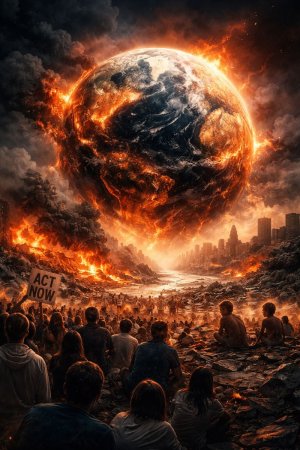
Letters To Editor By Alan Fitpatrik It has become strangely normal to live in a moment where the planet is warming, wars drag on without clear ends, and scientific breakthroughs quietly move forward while political arguments stay stuck in place. We are surrounded by evidence of what humans can do at their best, yet governed too often by systems that reward delay, fear, or brute control. This contrast is not abstract. It shows up in flooded neighborhoods, in families displaced by conflict, and in the widening gap between those who can afford to adapt and those who cannot. When leaders cling to power through force or deception, it is rarely the powerful who suffer first. It is the poor, the yo… |

|
Amber Glenn Shocked Over What Madonna Said About Her
The collision of elite sport and pop iconography rarely transcends the level of a well-managed PR stunt, yet the moment Amber Glenn stared into a screen to find Madonna staring back was different. It was a rupture in the sterile, high-pressure atmosphere of the Olympic village. Glenn, a 26-year-old from Plano, Texas, was already carrying the weight of a nation’s expectations and the personal history of a career defined by "almosts" and "not quites." When the Queen of Pop—the woman whose 1989 anthem "Like a Prayer" Glenn had chosen as her battle cry—spoke directly to her, the athlete’s physical composure dissolved. "I’m legitimately shaking," Glenn admitted. In that trembling, we saw the inte… |
|
5 year old girl swept into ocean off Laguna Beach is identified and mourned
The body of a 5-year-old girl who was swept into the ocean with her family in Laguna Beach before vanishing in dangerously high surf has been recovered. The girl’s body was spotted during an aerial coastline survey about 1:30 p.m. Thursday near Christmas Cove, about a quarter of a mile away from where she was initially lost at Treasure Island Beach, the city announced in a news release. The child was later identified as Amada Mia Brown of San Bernardino, said Sgt. Lizbeth Gwisdalla of the Orange County Sheriff’s Department. Amada’s father, Aaron Brown, described his daughter as full of life and “a sweet little baby” in an interview with NBC. “She loved the beach and she wasn’t afraid of wate… |

|
18-year-old girl killed in fiery crash
A a teenage girl was among the teens killed in a violent incident that occurred early Sunday morning. Near Farley, Missouri, on State Highway 45, an overturned automobile carrying 18-year-old Tessa Walker caught fire and killed her. The accident injured four other teenagers. Tessa Walker, a Park Hill School senior, was preparing to start her college career in the autumn at Northwest Missouri State. Besides being an accomplished athlete, Tessa was a hard worker in the classroom. She participated in track, girls' flag football, and volleyball. She participated in the AVID college-readiness program for all four years, and her dedication paid off with many awards, including academic scholarships… |

|
Audrey Hepburn Biography
Audrey Hepburn was a British actress and philanthropist who lived from 1929 until 1993. Hepburn was a big figure in Hollywood in the 1950s and 1960s. She starred in famous movies including Roman Holiday (1956), The Nun's Story (1956), and Breakfast at Tiffany's (1961). Later, Audrey Hepburn stopped acting and became a UNICEF ambassador. Audrey Hepburn was born in Belgium on May 4, 1929, to an English father and a Dutch mother. Because her father worked as an insurance salesman, the family moved a lot between England, Holland, and Belgium. Her parents split in 1935, in part because her father was a Nazi sympathizer. Audrey, who was six years old at the time, said subsequently that the divorce… |

|
Did Donald Trump suffer a serious stroke
Opinion | Editorial A sitting president allegedly suffered a stroke in 2025, and the White House kept it secret. The claim, reported by a doctor, is explosive not because it is unprecedented but because it fits a long tradition of concealment. American democracy has always struggled with the tension between transparency and control, between the public’s right to know and the state’s instinct to protect power. If Donald Trump did suffer a stroke, and if his administration hid it, then we are not simply talking about one man’s health. We are talking about the erosion of democratic accountability itself. The presidency is not just another job. It is the most powerful office in the world, and it… |

|
The First Years of Elvis Presley with his Parents
Exclusive Feature The church in Tupelo was quiet that morning, sunlight spilling through tall windows. Gladys Love Smith sat near the front, hands folded, eyes were soft, her posture shy. Vernon Elvis Presley entered late, shoulders bent from the weight of small burdens, his clothes plain, his steps uncertain. Yet when he looked up, his gaze caught hers, and their feelings soared. Gladys lowered her eyes quickly, cheeks warm. “Don’t stare,” she whispered to herself, though her heart beat faster. Vernon lingered in the aisle, hesitant, then slid into the pew across from her. His voice was low, almost unsure, when he leaned slightly and said, “Do you come here often?” Her lips parted, but her … |

|
Gulf strikes stoke concerns of new conflict with Iran
Uncertainty hung over the survival of a fragile ceasefire between the United States and Iran on Monday as a new wave of strikes on the United Arab Emirates and Oman and rumors of attacks on ships in the Strait of Hormuz undercut trust in the truce. The drone and missile attacks, the first since a truce ended combat earlier in April, came after the Trump administration started a wide-scale naval operation Monday to “guide” trapped maritime vessels out of the critical channel. However, concerns of a resumption of warfare have sparked yet another rise in the price of oil, which has shot up to above $114 a barrel, a level not seen since the truce over a month ago. The Gulf has trapped hundreds o… |

|
Energy Realism. Physics Over Slogans
Opinion | Feature Editorial Energy Realism: Physics Over Slogans The Grid at Midnight Picture a city at midnight. The wind has calmed, solar panels are dark, and the grid leans heavily on backup power. Politicians speak of “green revolutions,” but engineers know the reality: electrons obey physics, not slogans. The global conversation about energy has become strangely unserious for something so foundational to modern life. We cling to absolutes, divide into camps, and prefer moral certainty over physical reality. The result is passion without progress. Part I: Energy as Physics, Not Branding Energy systems are not ideological constructs. They are physical networks governed by constraints: st… |

|
Will America Go To War With NATO Over Greenland
Feature Editorial The United States is now openly challenging NATO, which theoretically could lead to WW3. What began as a crude discussion about purchasing has evolved into strategic pressure, which often transcends boundaries when power disregards its obligations. This conflict is no longer solely about Arctic bases or melting ice lanes; it raises the critical question of whether the United States is willing to fracture the very system it established, whether an alliance built to stop war can hold when the danger comes from the United States itself. The Arctic used to feel distant, a white silence at the edge of maps where ambition froze before it could speak. That illusion is gone. Greenl… |